by Lynn K. Patricia
Minneapolis / St. Paul
Shiatsu Anma was created in
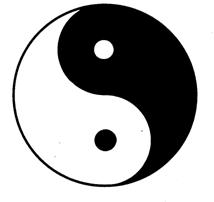
Yin and Yang are two ends of a spectrum, two polar complements. They are not forces or entities. They are not paranormal phenomena. The terms are just convenient labels used to describe how things function in relationship to each other and the universe. The idea is very similar to western anatomical terms of anterior/posterior, superior/inferior. Yin means “the shady side of the slope.” Yang means the “sunny side of the slope.” When we use the phrase “yang energy,” it is referring to the yang aspects of the thing in question. The phrase does not refer to an independent force called “yang.” (The word "yang" rhymes with “yon” as in “yonder." It does not have the long "a" sound of "bang".)
Aspects associated with Yin (imagine the side of a mountain that never receives the sun):
Cold, damp, darkness, stillness, passivity, inward, downward (cold air sinks), decrease, decay, etc.
Aspects associated with Yang (imagine the side of a mountain that gets a lot of direct sun):
Heat, dryness, light, movement, activity, outward, upward (hot air rises), increase, growth, etc.
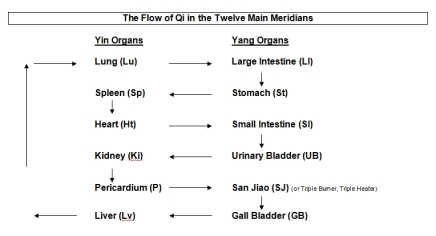
In a healthy state, there is a harmonious flow of the yin and yang aspects of the human body from superior to inferior and interior to exterior. Over thousands of years, Chinese physicians have mapped these harmonies as channels or pathways called “meridians.” The Chinese term is “jing-luo.” Jing means “to go through” or the verb "thread." Luo means “something that connects or attaches” or “a net.” It is an invisible network but is fundamentally physical in nature governing physical relationships. Yang channels (channels with mostly yang aspects) lie more superficial, yin channels lie deep. Yang channels are more lateral, yin channels more medial. As these channels pass through the body, they resonate with similar structures and organs in the body. Channels that are more yang will resonate with organs that are more yang. For example, one of the most yang meridians on the body is the one that runs from the thumb, up the lateral side of the arm to the nose. It resonates with one of the most yang organs in the body, the large intestine. (The large intestine is considered yang because it is large, hot, makes noises, processes food and actively moves it out of the body.) Here in the west, meridians are referred to by the major organ they resonate with. Therefore, we refer to this meridian as the Large Intestine meridian, or “LI” for short.
There are 12 main meridians in the body associated with 12 major organs. (Keep in mind that TCM defines organs differently than western anatomy.) These meridians travel through the body much like electrical wires travel through the walls of your home. They have points that rise close to the surface, much like an outlet where you plug in your computer. They have points that act like a light switch. And they have entry and exit points like the fuse box that controls electricity coming into your home. In ancient
What exactly circulates through these channels? The vital substances inherent to all organic life:
Jing: translated as “thread of essence.” It is that energy and substance that brings birth, growth, and the ability to reproduce.
Qi: pronounced “chee.” It is the life energy, the animating force that moves living beings. The enlivening force that leaves us at the moment of death. The thing that gives us locomotion and helps us move through and interact with our world.
Shen: feeling and expression, our personality, our heart or spirit.
Blood: The substance that provides the fuel and nutrition. In TCM, “blood” refers to more than just the red fluid that western medicine calls blood.
Fluids: all bodily fluids other than blood. Sweat, saliva, urine, etc.
As a person goes through daily life, these channels can become weak or blocked. This will upset the balance of yin and yang and ultimately weaken or block the flow of substances. Rather than calling this imbalance a “disease,” it is referred as a “disharmony.” With Shiatsu Anma, we try to manipulate the yin and yang aspects of the each meridian to facilitate the flow of substances, especially Qi. If a channel is blocked or weakened, it will create symptoms of disharmony in a body part along the channel, or in the channel that is before or after it in the flow of Qi. Because yin, yang, and the vital substances are so interdependent, we can only understand a disharmony by considering all parts of the whole as looking at the big picture for patterns of disharmony. In other words, if a client complains of a headache, we must look at the functioning of the organs, meridians, and substances to determine a course of action. Each client’s headache will only be one small piece of the puzzle. One headache could be accompanied by sleeplessness and diarrhea, another with malaise and constipation. These two headaches would result in two completely different treatments.
Copyright 2006-2008, Lynn K. Patricia